
As this year winds down, many teams are taking a well-deserved breath. But in the world of fraud prevention, the pace rarely slows—and the forces reshaping the landscape in 2025 are already defining what comes next.
Generative AI has lowered the barrier to deepfakes and synthetic identities. Fraud-as-a-service networks are advancing with alarming speed. Autonomous AI agents are entering the mainstream. And identity-based attacks have grown not only in volume, but in sophistication. Every organization working to protect what’s real—their customers, revenue, and reputation—now faces threats that look more “real” than ever.
Each year, we gather insights from leaders across digital identity, fraud detection, financial crime, telecommunications, and risk management. The message for 2026 is consistent: the threat landscape will intensify, but so will our ability to defend against it.
This forecast is designed to help you understand what’s ahead, anticipate how attackers will evolve, and take practical steps today to strengthen trust and resilience.
2025 was the spark. 2026 will be the blaze.
Looking back, 2025 was a year of rapid change. Identity fraud didn’t just evolve, it multiplied.
Attackers blended AI-powered impersonation, deepfakes, behavioral manipulation, and automation into highly effective schemes. Regulatory expectations grew more defined. And the push for stronger, more transparent identity assurance became universal.
These shifts aren’t slowing down. They’re setting the pace for 2026.
Organizations across industries are asking the same questions:
How do we stay ahead? How do we adapt? How do we protect what’s real when the threats look more “real” than ever?
This forecast is designed to help you understand what’s ahead, anticipate how attackers will evolve, and take practical steps today to strengthen trust and resilience.
2026 predictions from industry innovators
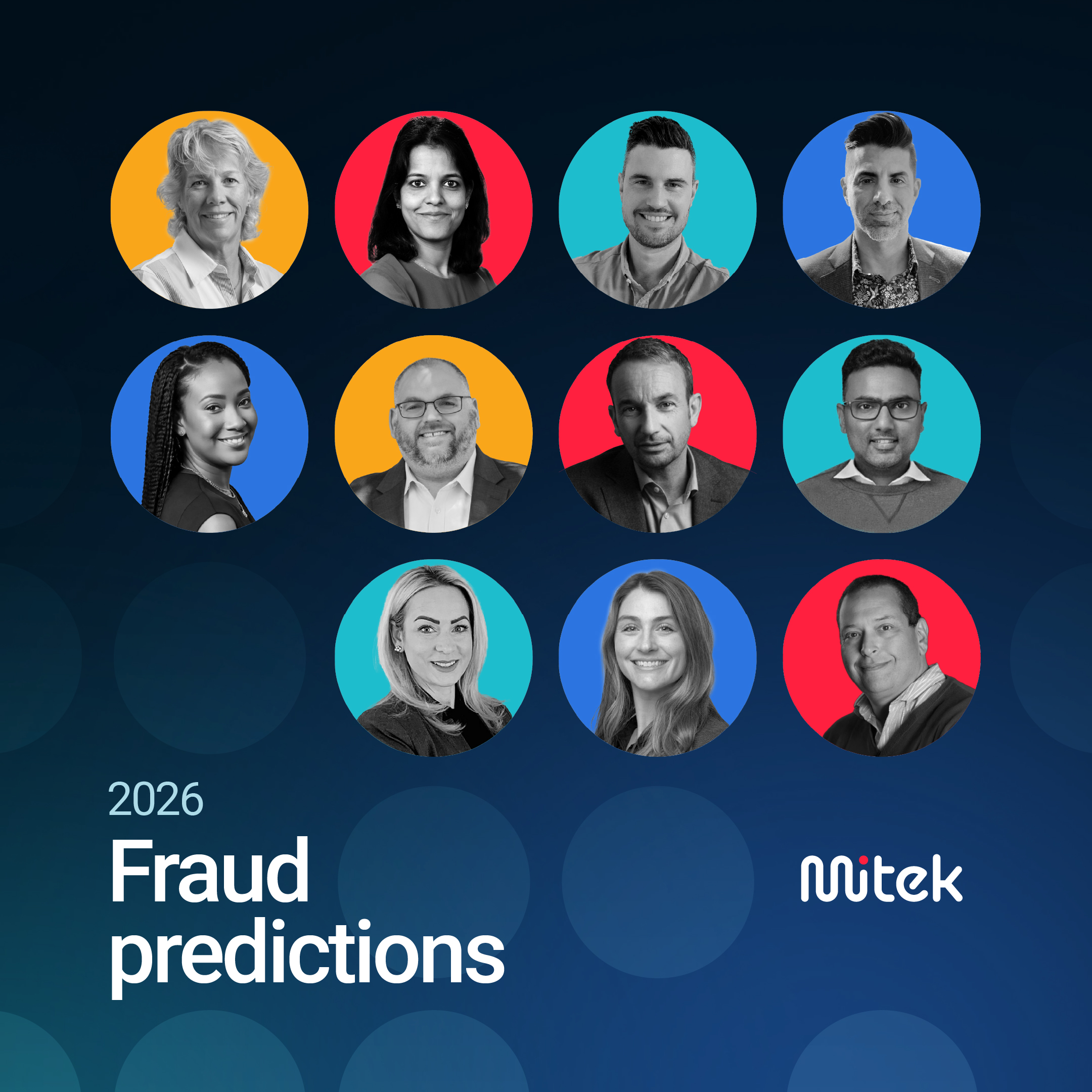
We turned to some of the most respected minds in fraud prevention and digital identity for their 2026 forecasts, at a moment when tomorrow’s challenges are rapidly becoming today’s realities. Each prediction reflects a defining shift for the year ahead, informed by leaders already navigating what comes next.
Forecast #1: AI becomes mission-critical for fighting fraud.
 Ravi Nemalikanti — Chief Product & Technology Officer, Abrigo
“Banks that began integrating generative AI in 2025 are now preparing to make it central to daily operations. In 2026 banks will increasingly rely on AI-powered solutions for critical tasks such as enhanced fraud monitoring, decision-making and process optimization. More than a third of institutions either have already integrated AI into key processes or have pilots underway, according to Abrigo’s survey of nearly 300 bankers. The data reinforces what leaders are already seeing on the ground: AI has moved from a theoretical advancement to a practical requirement for institutions seeking efficiency and competitiveness.
In the AML/CFT and fraud space, AI-powered tools are a tactical solution to staffing issues. An Abrigo poll of more than 90 FinCrime professionals revealed that 43% are most concerned about staffing and not being able to keep up. By leveraging AI to reduce false positives, detect emerging threats, and streamline compliance reporting, financial institutions can enhance their fraud and BSA programs without adding to headcount.”
Forecast #2: Fraud defenses shift from reactive to fully predictive.
 Adam Johnson — CIAM Lead UKIA, Accenture
“In 2026, fraud prevention will pivot from detecting anomalies after they occur to proactively ‘pre-empting’ fraud through AI-driven behavioural baselines. Defences will become more harmonised and collaborative, operating continuously and in real-time to learn an individual’s digital identity across devices, biometrics, and contextual signals. This shift means fraudsters will face adaptive systems that anticipate their moves before they strike, making traditional credential theft or synthetic identities far less effective. We’ll also see significant strides in reshaping digital trust with verified decentralised identities and AI-powered risk scoring converging to create a world in which proving you are who you say you are becomes frictionless for consumers but nearly impossible for bad actors.”
Forecast #3: Synthetic fraud becomes the defining threat of 2026.
 Adam Bacia — Vice President, Product Marketing, Mitek
“2026 is going to see a tsunami of synthetic fraud. Generative AI (GenAI) has amplified this attack vector exponentially by enabling fraudsters to create highly convincing full ‘identity kits’ that include realistic IDs, selfies, and even deepfake videos that (when injected) can bypass basic verification checks at scale. That coupled with the ubiquity (and frighteningly low cost) of real user data available to fraudsters, means anyone with a decent laptop and a credit card can now execute highly advanced fraud attacks en masse.
Typically, fraud doesn’t scale because criminals are clever, it scales because the tools at their disposal make it easy… and the tools for synthetic fraud are now abundant.”
Forecast #4: Agentic AI reshapes customer behavior—and fraud patterns with it.
 Karen Boyer — M&T Bank
“The rapid rise of Agentic AI agents now capable of autonomously transacting, shopping, opening accounts, aggregating data, etc. marks a fundamental shift in digital engagement. These systems remove human intervention from critical processes, creating new blind spots for traditional fraud detection technologies. Legacy models, built to monitor human-driven behaviors, must now adapt to identify autonomous patterns which historically fit classic fraudulent payment blueprints. It may pose a challenge for historical models to understand this activity may now be what the ‘new normal’ looks like regarding customer behavior. This evolution demands a rethinking of detection frameworks to account for dynamic, goal-driven agents operating across multiple platforms in real time.
As the line between malicious scripting and legitimate agentic activity blurs, determining the difference becomes a competitive advantage. Fraudsters can exploit these capabilities to scale attacks with unprecedented speed and sophistication, while early adopters, who most often are the most tech-savvy and high-value customers, risk being caught in outdated controls. Success for all companies and industries will hinge on intelligence-led strategies that combine behavioral analytics, adaptive authentication, and continuous monitoring to distinguish between threat actors and trusted autonomous agents in this new era of intelligent automation.
Finally, this evolution paves the way for a new wave of first-party fraud, where dispute abusers can conveniently ‘blame the AI,’ claiming that an autonomous agent acted without their consent. This narrative of ‘the agent went rogue’ creates a plausible cover for fraudulent chargebacks and unauthorized activity. While legitimate customers may occasionally face similar risks, fraudsters will exploit this loophole aggressively and at scale, leveraging ambiguity to undermine accountability and detection frameworks.”
Forecast #5: Deepfakes and synthetic identities overwhelm outdated defenses.
 John Fick — Director of Fraud, Northwest Bank
“Fighting fraud often feels like a game of whack-a-mole and here we go again with generative AI changing the rules entirely. What was once a niche threat is now a full-scale crisis. Synthetic identities and deepfakes have moved from the shadows to center stage, slipping past traditional defenses with unnerving precision. Fraudsters can fabricate entire personas and documents at scale, eroding trust in identity verification systems. Deloitte warns AI-enabled fraud could soar to $40 billion by 2027, up from $12.3 billion in 2023, a staggering 32% annual growth rate. The takeaway? Identity verification must evolve with advanced biometrics, forensic analysis, and shared intelligence or risk catastrophic losses.”
Forecast #6: Organized crime diversifies and intensifies digital fraud attacks.
 Donna Turner — Founder, Risk Insight Solutions
“The threat environment will deteriorate further. The global pressure on transnational organized crime groups behind trafficked labor and scam compounds, will force them to diversify and attack anew in areas of account opening, account takeover as well as a continued level of attack on all forms of scams. Consequently 2026 will be the year of the fraud fighter. We will see an accelerated push for evolved solutions that leverage AI for good and take the ability to confidently use an identity to new levels.”
Forecast #7: Fraud moves from single-event attacks to AI-driven ecosystems.
 D’Janne Thomas — Senior Operations Manager, Trust & Safety, Upwork
“In 2026, fraud prevention will pivot from chasing single suspicious events to dismantling entire AI-driven fraud ecosystems. Bad actors are already using generative AI to stitch together synthetic identities, mule networks, and deepfake communications that slip past traditional defenses. The breakthrough will come from layered, network-level intelligence: behavioral biometrics that expose subtle anomalies in how people interact, synthetic identity detection at scale, and federated data-sharing frameworks that allow institutions to spot fraud rings without sacrificing privacy.
The real shift is cultural. Trust will no longer hinge on whether a transaction looks safe, but on whether the system itself can prove it’s resilient against coordinated, AI-powered attacks. Fraudsters will find themselves outmatched not transaction by transaction, but network by network.”
Forecast #8: Global device demand fuels a surge in theft, trafficking, and telecom fraud.
 Steve Schwed — Senior Fraud Strategy Manager, Verizon
"Based on projections the telecommunications industry has seen from the GSMA, there is an anticipated additional 1B connections expected globally by 2030 in the Sub-Saharan African, Northern African, Middle East and Pacific Rim countries. The demand for low-cost devices in these emerging regions will ultimately drive additional demand for upwards of 10 million or more fraudulently obtained or stolen devices over the next 5 years on top of those which are trafficked to meet demand in those regions of the world today. Carriers and consumers alike should prepare for the increased velocity of attacks to meet this increase in demand and use whatever methods that they can to create improved loss prevention. Additionally, carriers should be better prepared to protect devices on display or out on the floor of stores as instances of robberies will likely increase as well."
Forecast #9: Identity shifts left as AI-driven fraud reshapes the front door.
 Ruchira Ghosh — Head of Enterprise CIAM, TD Bank
"In 2026, AI-driven fraud will pressure every stage of identity proofing and authentication. Phishing, social engineering, deepfakes, and AI-generated documents are becoming systemic threats, particularly across KYC and onboarding, making it harder to distinguish legitimate customers from synthetic identities.
The focus will shift left to identifying the anamoly sooner and incentivize the true customer with straight thru processing, ensuring good users enter cleanly and securely with minimal friction. While strengthening the front door remains essential, institutions must also clearly understand who they are protecting against as threats evolve.
As customers move further into digital-only, mobile-first interactions and cryptocurrency-driven money movement, traditional trust signals will erode. Fraud teams will need to move from probabilistic assumptions to deterministic identity—confidently knowing who is behind the device, browser, or transaction. Having a layered approach to trust the customer but verify at every stage of the customer journey is key to manage and reduce risk.
With new payment rails and attack methods constantly emerging, fraud prevention will continue to accelerate. Success in 2026 will depend on continuously strengthening identity assurance without sacrificing the customer experience. Leveraging a multi layered control defense along with streamlined detect, respond and react procedures will help organizations reduce risk while serving our customers."
Forecast #10: The next wave of fraud won’t hack banks, it will persuade customers.
 Candice Levine — Vice President of Fraud Controls, Morgan Stanley
“In 2026, the greatest vulnerability won’t be broken systems, it will be trusted customers. Financial institutions have made major strides in securing the 'front door,' but fraudsters no longer need to break in when customers are unknowingly handing over the keys.
The sophistication of social engineering is reaching a tipping point. As deepfakes, impersonation, and AI-generated communications blur the line between what’s real and what isn’t, customers will increasingly believe they’re interacting with legitimate institutions or trusted advisors, when they’re not. The result won’t look like a traditional account takeover. Instead, customers themselves will become the point of entry, acting in good faith while fraud unfolds behind the scenes. This shift will force organizations to rethink fraud strategy beyond perimeter defenses, focusing instead on customer-aware controls, real-time confirmation, and education that helps users recognize when something feels off—and when verification truly matters."
Forecast #11: Real-time intelligence will become the best defense for organizations against scams.
 Craig Tebbutt — Chief Strategy & Innovation Officer, UK & Ireland, Equifax
“Authorized Push Payment (APP) fraud and social engineering will remain a threat in 2026, for both consumers and the financial services industry alike. The increasing adoption of real-time payment systems are fueling APP growth, with fraudsters' using technologies such as generative AI, deepfakes, and automated social engineering to scam legitimate customers.
Banks and financial institutions that continue to rely on traditional, reactive and static rule-based fraud detection systems will struggle against innovative, real-time criminal networks. A shift towards global and real-time intelligence solutions, including advanced AI, machine learning, and behavioral biometrics, is needed to change from reactive to proactive identify and block scams before funds are lost to bad actors forever."
What you can do now to prepare for 2026
Predictions matter. Being prepared matters more.
1. Shrink your blind spots.
Expand intelligence inputs, train teams on emerging threats, and examine where AI-enabled fraud could slip through your processes.
2. Get organized before attacks evolve.
Audit your full identity and fraud stack, map lifecycle risks, and align your teams (fraud, security, product, compliance) before January.
3. Build for the unforeseen.
Adopt configurable flows, real-time anomaly detection, and fast response loops capable of adapting to unpredictable AI-driven attacks.
4. Strengthen layered, adaptive defenses.
Document checks, biometrics, behavioral analytics, device intelligence, and continuous monitoring work best together, not in silos.
5. Prioritize collaboration and shared intelligence.
Fraudsters share tactics and tools, and stopping them requires a trusted community working together.
Why 2026 will be a defining year
AI is rewriting the rules. Fraud networks are maturing. Organized crime is shifting. Regulations are tightening. And consumers expect trust by default.
Organizations that modernize early—those that adopt adaptive defenses, continuous identity assurance, and intelligence-led strategies—will lead in trust, safety, and resilience.
The signals for 2026 are already here.
Watch the 2026 Fraud Forecast: Understanding the Cycles of Risk webinar to hear directly from industry experts on how to turn foresight into preparedness.
Conor Rector — Marketing Director at Mitek

Conor Rector is a content and customer advocacy leader focused on helping people understand identity, fraud prevention, and the technology shaping how we protect what’s real. With a background spanning storytelling, brand strategy, and community building, Conor brings a thoughtful, human-centered approach to complex topics.