
Check liveness is a fraud detection capability that helps financial institutions determine whether a remotely deposited check is a live, original document or a reproduction, such as a photo of a photo, printout, or digitally altered image.
By adding check liveness to Check Fraud Defender, Mitek gives banks and credit unions another signal for detecting counterfeit, altered, and potentially fraudulent checks before they create losses or require manual review.
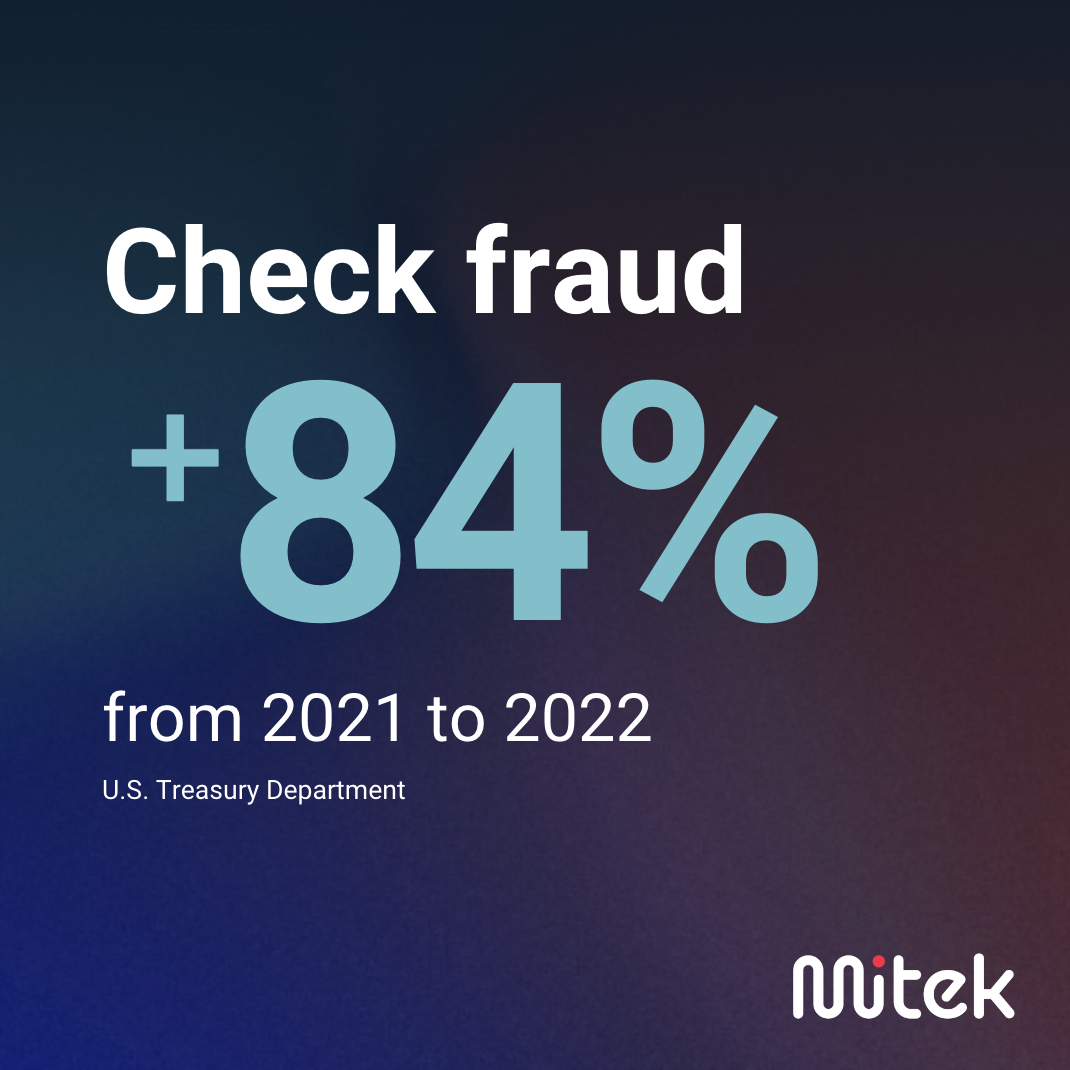
According to the U.S. Treasury Department, reported check fraud rocketed from 250,000 cases in 2021 to 460,000 in 2022 – an 84% increase. That comes despite a volume increase in checks of just 8% in 2021. All of which prompts the question, “why?”.
Check fraud itself isn't new. But the accessibility of the dark web and encrypted messaging apps acting as online marketplaces for the sale and purchase of stolen check images provides fraudsters with new and highly profitable channels for their illicit trade.
Research from Georgia State University’s Evidence-Based Cybersecurity Research Group found that in the groups they observe, an average of 1,325 stolen checks were sold this way every week in October 2021, up from 409 in August of that year and just 158 per week in October 2020. These figures likely only represent a small fraction of the number of checks being stolen and sold given they focused their work on only 60 online fraud markets.
In February, the Financial Crimes Enforcement Network (FinCEN) issued an alert to financial institutions warning them of a surge nationwide in check fraud schemes targeting the U.S. Mail.
Attempting to gain access to mailed checks, criminals will typically break into a mailbox using master keys that can also be purchased on the dark web. They will then ‘wash’ the checks they obtain using commonly sold cleaning products, erasing the intended payee’s name and the amount displayed on the check and replacing the information with the purchaser’s preferred payee details and a new amount – which could be thousands of dollars higher than the original.
These scanned images of checks are then used for remote deposit, bypassing traditional fraud detection technology which cannot determine between an image of a live check and a picture of a picture of a check.
Learn more about Check Fraud Defender
What is check liveness?
Check liveness is a document-authenticity signal used in remote deposit fraud prevention. It helps determine whether a customer is presenting an original, physical check or a reproduction of one.
A check may be suspicious if it appears to be:
- A photo of another image of a check
- A printed or copied check image
- A digitally manipulated check
- An image captured from a screen
- A check that has been altered after issuance
Check liveness does not replace other fraud controls. It adds another layer of evidence that financial institutions can use alongside image analysis, duplicate detection, document verification, transaction monitoring, and manual review workflows.
Check liveness: reducing fraud, reducing costs
To confront these challenges, Mitek has enhanced Check Fraud Defender, arming it with a new feature; check liveness.
Check liveness adds another signal to banks’ defenses, enabling them to determine if a check is a live check or a picture of a picture of one. This additional feature strengthens financial institutions’ ability to counteract different types of check fraud as the sophistication of crimes grows. In a recent test of 2,000 real and fake documents, check liveness showed a 93.3% accuracy rate.
“As check fraud continues to increase in the U.S., financial institutions need to make sure the correct safeguards are in place to protect their organizations and individuals,” said Drew Edwards, CEO, Ingo Money. “With added signals of counterfeit documents, banks of all sizes can stay ahead of criminals to fortify institutional protocols and drastically reduce fraud-related losses.”
Check Fraud Defender reviews 18 check attributes to determine if a document is authentic, helping reduce the costs associated with manually reviewing potentially fraudulent checks.
“Over the past few years, technology has made fraudsters smarter, and they have found new vulnerabilities to exploit. The sophistication of these crimes means more check fraud is slipping through the cracks,” said Michael Diamond, senior vice president and general manager, Mitek.
“Check Fraud Defender is the first line of defense for financial institutions. With added signals, like check liveness, banks of all sizes can answer the question: What’s fake and what’s real? .”
Mitek Check Fraud Defender uses check liveness as an additional signal in its broader check fraud detection process. The capability helps financial institutions evaluate whether a deposited check is likely to be an original document or a reproduction intended to bypass traditional image-based controls.
Check Fraud Defender reviews multiple check attributes to help assess document authenticity and identify potentially fraudulent deposits. Adding check liveness strengthens that assessment by helping banks detect image-based fraud tactics that can be difficult to identify through traditional review alone.
In a test involving 2,000 real and fake documents, check liveness demonstrated a 93.3% accuracy rate. Results may vary based on image quality, deposit workflow, fraud patterns, and an institution's overall fraud-control environment.
Benefits of check liveness for banks and credit unions
Check liveness can help financial institutions strengthen remote deposit fraud prevention in several ways:
- Detect potentially fraudulent reproductions before funds are made available
- Add another signal for identifying counterfeit and altered checks
- Reduce unnecessary manual review of legitimate deposits
- Support faster fraud investigation and decision-making
- Help reduce operational costs associated with check fraud losses
- Strengthen layered defenses as fraud tactics evolve
For best results, check liveness should be part of a broader check fraud strategy that combines document analysis, transaction risk signals, deposit limits, customer behavior monitoring, and case-management processes.
How check liveness works in a remote deposit workflow
A typical check liveness workflow can include the following steps:
- A customer captures images of the front and back of a check through a mobile or digital banking experience.
- The fraud detection system analyzes the submitted image for signals that indicate whether the check appears to be an original physical document or a reproduction.
- The system combines check liveness with other document and fraud-risk signals.
- The financial institution uses the resulting risk assessment to approve the deposit, route it for additional review, apply a hold, or decline the transaction based on its policies
Who should consider check liveness?
Check liveness may be especially relevant for:
- Banks offering mobile remote deposit capture
- Credit unions expanding digital deposit services
- Financial institutions experiencing increased counterfeit or altered check activity
- Fraud operations teams seeking to reduce manual review volume
- Digital banking teams looking to improve deposit security without adding unnecessary customer friction
Institutions should evaluate check liveness within the context of their existing fraud controls, risk appetite, customer experience goals, and deposit workflows.
Check liveness is designed to support fraud teams and digital banking teams with faster, more informed deposit decisions.
Contact us to learn more about check liveness, a feature of Check Fraud Defender.
Evaluate check liveness for your deposit fraud strategy
Check liveness adds another layer of defense against counterfeit, altered, and reproduced check images submitted through remote deposit channels. Learn how Mitek Check Fraud Defender can help your institution detect suspicious checks earlier, reduce fraud risk, and support more efficient deposit review workflows.
Frequently asked questions
What is check liveness?
Check liveness is a fraud detection capability that helps determine whether a remotely deposited check is an original physical document or a reproduction, such as a photo, copy, printout, screen image, or manipulated
Can check liveness prevent check fraud?
Check liveness can help detect certain forms of remote deposit check fraud, particularly fraud involving reproduced or manipulated check images. It is most effective when used as part of a layered fraud prevention strategy.
What is a photo-of-a-photo check fraud attack?
A photo-of-a-photo attack occurs when a fraudster submits an image of a check that is itself a photograph, printout, screen image, or other reproduction rather than an original physical check.
How does check liveness help banks reduce manual review?
Check liveness adds another document-authenticity signal to the fraud decisioning process. This can help fraud teams prioritize higher-risk deposits for review and reduce time spent investigating lower-risk transactions.